Why do you have to increase Mounjaro dose?
Patient Guides
30 December 2025
By
If you’ve started Mounjaro (tirzepatide), you’ll notice something that surprises a lot of people: the dose usually goes up in steps. That can feel odd—if a medication is “working”, why change it?
The short answer is that Mounjaro is designed to be titrated (increased gradually). The goal isn’t to make life complicated. It’s to help your body adjust, reduce side effects, and—where appropriate—reach a dose that gives you the best balance of results and tolerability. Medicines.org.uk
Below is the plain-English explanation of why dose increases happen, what the usual schedule looks like, and when it’s sensible to pause or stay on a lower dose.
1) The first increase (2.5 mg → 5 mg) is part of the standard plan
In UK prescribing guidance for Mounjaro, 2.5 mg once weekly is the starting dose. After 4 weeks, the dose should be increased to 5 mg once weekly.
That first month at 2.5 mg is best thought of as your “settling in” phase—your body gets used to the medication’s effects on appetite, digestion, and blood sugar regulation.
Why not stay at 2.5 mg?
Because 2.5 mg is primarily used to start treatment and improve tolerability, rather than being the dose most people stay on long-term. Many people will see some appetite change early, but the treatment plan usually aims to move beyond the starter dose.
2) Dose escalation is mainly about tolerability (and your gut will thank you)
Mounjaro affects gut hormones and slows gastric emptying for many people—this is part of how it supports weight loss and metabolic health, but it’s also why nausea, reflux, constipation, or diarrhoea can show up, especially early on.
Increasing gradually gives your system time to adapt. The official dosing approach allows increases in 2.5 mg steps with at least 4 weeks at each level, specifically to support safe titration.
In real life, this means:
-
You don’t “push through” severe side effects just to hit a number.
-
A slower increase can be the difference between quitting and succeeding.
3) Higher doses can mean better results (but only if you tolerate them)
Some people do brilliantly at 5 mg. Others need 10 mg or 15 mg to get the appetite control and weight loss they’re aiming for.
UK guidance describes maintenance doses of 5 mg, 10 mg, and 15 mg, with 15 mg once weekly as the maximum.
A helpful way to think about it:
-
Lower doses: often enough for some people, especially if they’re sensitive to the medication.
-
Higher doses: may provide stronger appetite suppression and metabolic effect for others—but side effects can also increase.
So you’re not “increasing for the sake of it”. You’re trying to find your effective maintenance dose—the dose that gives you good results you can actually live with.

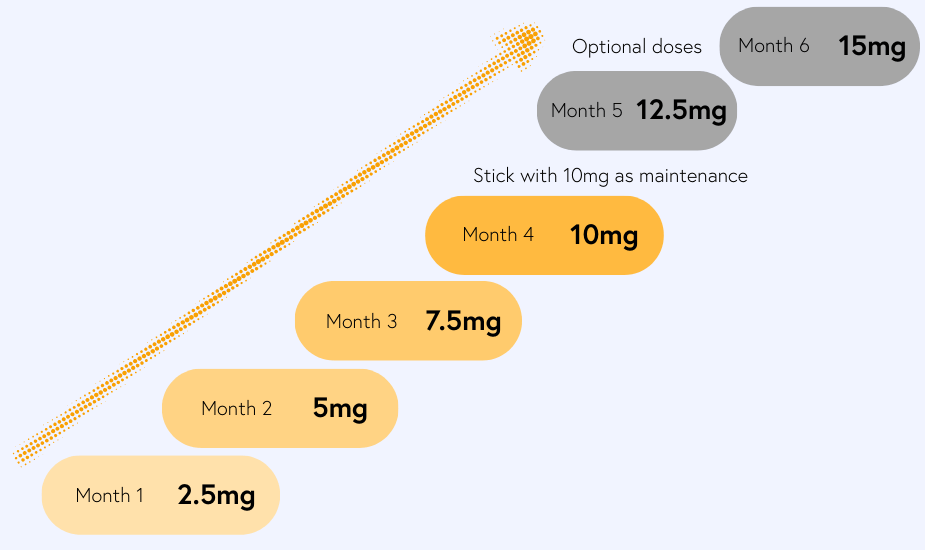
4) The “usual” Mounjaro dose escalation schedule (UK-style)
Here’s a typical step-up pattern many clinics use, consistent with the product information:
| Weeks | Dose (once weekly) | What it’s for |
|---|---|---|
| 1–4 | 2.5 mg | Starter dose to improve tolerability |
| 5–8 | 5 mg | First maintenance-level step |
| 9–12 | 7.5 mg | Optional step if more effect needed |
| 13–16 | 10 mg | Common maintenance dose |
| 17–20 | 12.5 mg | Optional step |
| 21+ | 15 mg | Max dose (if needed/tolerated) |
5) Do you have to increase every month?
Not necessarily.
After you reach 5 mg, further increases are usually based on two questions:
-
Are you tolerating the current dose well?
-
Are you getting the clinical effect you need? (appetite, weight trend, metabolic markers, cravings, binge urges, etc.)
NICE’s practical guidance for tirzepatide in weight management suggests titrating if tolerated and if not already at the maximum effective dose, typically 2.5 mg every 4 weeks. NICE
So in plain English: if you’re doing well, you might stay put. If progress has stalled and you’re tolerating it, a step-up may help.
6) Why weight loss can slow down if you don’t increase
This is one of the most common frustrations: the first weeks feel powerful, then things calm down.
That doesn’t mean Mounjaro “stopped working”. It often means:
-
Your body has adapted to a lower dose,
-
Your appetite has improved but not enough to maintain a steady calorie deficit,
-
Lifestyle factors (sleep, stress, alcohol, snacking) are blunting the effect,
-
Or you’ve simply reached the limit of what that dose can do for you.
In those situations, a higher dose can restore momentum—but only if it’s safe and appropriate for you.
7) When you should not increase your dose (and may need to pause)
A dose increase is a bad idea if you’re already struggling. Examples include:
-
Ongoing significant nausea or vomiting
-
Dehydration, dizziness, inability to keep fluids down
-
Severe constipation
-
Worsening reflux that’s affecting sleep
-
New or severe abdominal pain
Also, if you use certain diabetes medications (like insulin or sulfonylureas), changing doses may affect hypoglycaemia risk, and your prescriber may need to adjust other meds. Medicines.org.uk
Red flags (don’t wait): severe abdominal pain (especially with persistent vomiting), signs of an allergic reaction, or symptoms that feel “not right”. Seek urgent medical help.
8) “Lowest effective dose” beats “highest dose” (almost every time)
There’s a misconception online that the goal is to “get to 15 mg”. That’s not the point.
The real goal is:
-
steady progress
-
minimal side effects
-
a plan you can sustain
For many people, that’s 5 mg or 10 mg. For some, it’s 15 mg. And occasionally, it’s stepping back down after reaching a higher dose.
If your appetite is controlled, weight is trending down, and you feel well—staying at your current dose is often the most sensible choice.
9) Practical tips to make dose increases easier
If you’re moving up a dose and want to reduce the chance of feeling rough:
-
Keep meals smaller for a few days after the injection.
-
Focus on protein first, then fibre, then carbs (simple, not obsessive).
-
Hydrate, especially if you’re prone to constipation.
-
Avoid high-fat “challenge meals” right after a dose change (they can hit harder).
-
If nausea is an issue, speak to your prescriber — sometimes timing and supportive meds can help.
Most importantly: if you’re dreading every injection day, that’s a sign the plan needs adjusting.
Frequently asked questions
How often do you increase Mounjaro?
Typically, no more often than every 4 weeks, and only if you’re tolerating the current dose.
Why do you start at 2.5 mg?
Because it helps your body adjust and can reduce side effects before moving to higher doses.
Do you have to go from 5 mg to 10 mg?
No. Many people stay on 5 mg for a while. Others step up if they need more effect and tolerate it well.
What is the maintenance dose of Mounjaro?
Common maintenance doses are 5 mg, 10 mg, or 15 mg once weekly (maximum 15 mg).
What if I can’t tolerate an increase?
You can often delay the increase, remain on the current dose longer, or step back down—your prescriber should guide this.
BMI Calculator
*If you have an Asian, Chinese, Middle Eastern, Black African or African-Caribbean family background:
- 23 to 27.4 – overweight
- 27.5 or above – obese